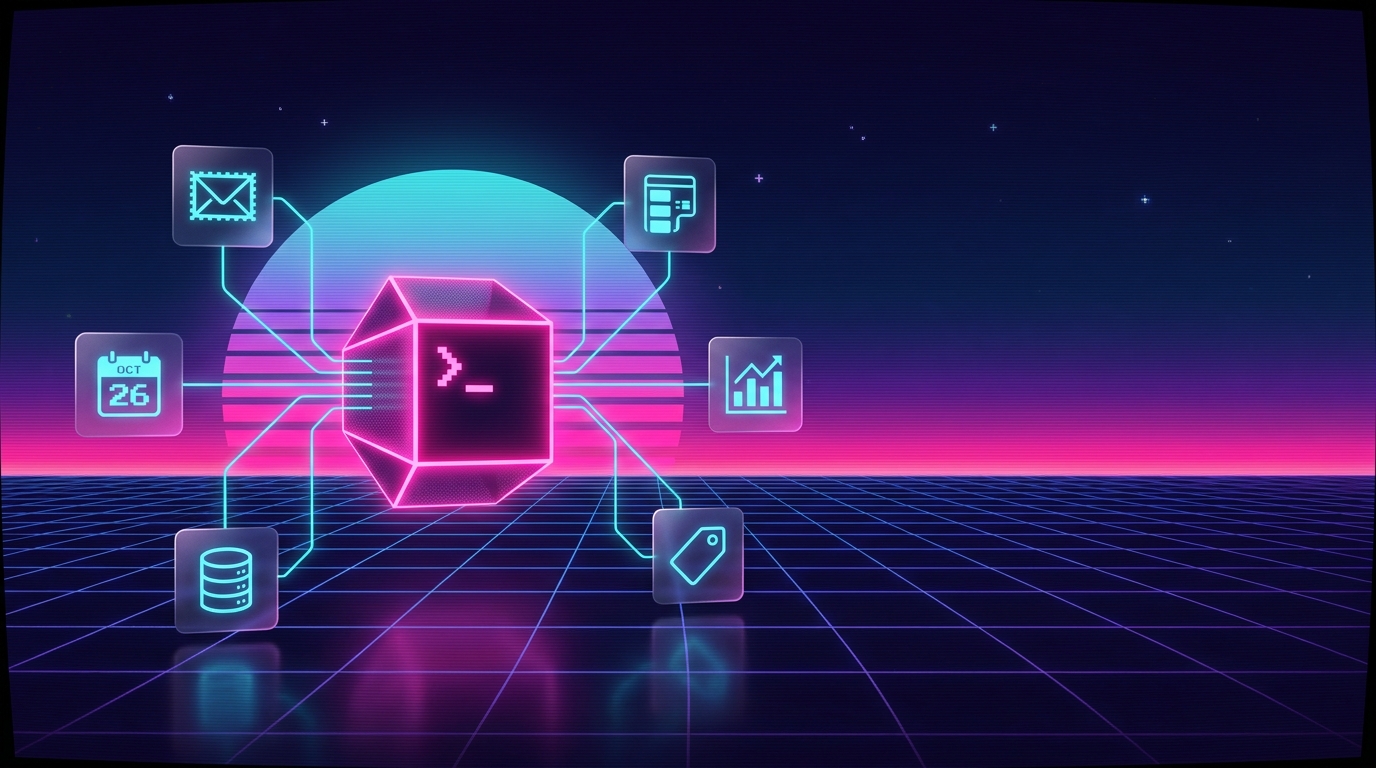
An AI agent is software that takes a goal, makes decisions, and runs actions across your tools without a human pushing every button. It is different from an AI chatbot, which only talks. It is different from automation like Zapier, which only follows fixed rules. A good agent reads context, picks a path, and uses real tools like email, your CRM, or your inventory system. Most businesses will build small, narrow agents that do one job well, not one super-agent that does everything.
What is an AI agent?
An AI agent is a piece of software that uses a large language model as its brain, has access to a defined set of tools (email, a CRM, a database, anything with an API), and is given a goal instead of step-by-step instructions. Where automation says "if X then do Y," an agent says "your goal is Y, figure out the steps."
Three things separate it from the AI you already know:
- It can act, not just answer. A chatbot writes a reply to your customer. An agent writes the reply, drafts a refund in Shopify, and updates your ticketing system, then waits for approval if it is a sensitive call.
- It reasons over context. Hand it a customer message, an order history, a refund policy, and a deadline. It works out what to do. You do not pre-script the workflow.
- It runs in a loop. Look at the situation, take an action, observe the result, take the next action, until the goal is done or it hits a guardrail.
AI agent vs. assistant vs. automation
These terms get conflated. They are not the same thing.
| Category | What it does | Decides anything? | Acts on real systems? | Example |
|---|---|---|---|---|
| Chatbot or assistant | Talks. Answers questions. | Picks words, not actions. | Rarely. Maybe pulls one thing from a knowledge base. | ChatGPT in a browser tab. |
| Automation (Zapier, Make) | Runs a pre-scripted flow. | No. Follows IF/THEN rules a human wrote. | Yes, but only what the script says. | "When a Shopify order comes in, write a row in Airtable." |
| AI agent | Decides what to do, then does it. | Yes. Picks from a tool palette to reach a goal. | Yes. Acts on real systems with guardrails. | "Handle this support ticket: read it, look up the order, draft a response, get human approval, send." |
A useful test: if you can fully describe the steps in advance, you want automation. If the right steps depend on what the agent finds along the way, you want an agent.
The parts of an AI agent
When someone says "we have an AI agent," they usually mean a small system with these pieces:
- A model (the brain). Usually Claude, GPT, or Gemini. The model reads what the agent sees and decides what to do next.
- Tools. APIs the agent can call. "Read this Gorgias ticket." "Look up the order in Shopify." "Send a Slack message." Each tool has a clear contract, like a function signature. The model picks which tool to use and with what arguments.
- A goal and a persona. A system prompt that defines the role (e.g., "You are a customer support specialist for a plant nutrient brand") and what counts as a successful outcome.
- Memory. Often files on disk or a database. The agent remembers what happened in past sessions, what the customer is like, what worked last time.
- Guardrails. Hard rules the agent cannot break. "Never issue a refund over $50 without human approval." "Never send a customer reply that contains an em dash." These are enforced in code, not in the prompt.
When agencies talk about an "agent fleet," they mean several of these working in coordination. A mature ecommerce fleet might include a chief-of-staff that routes work to the right specialist, a customer support agent, a finance agent that builds the daily P&L, a content agent that writes blog articles, a sales agent for B2B outreach, and a few others. Each one is small and narrow. The big system is the orchestration between them.
Sub-agents and skills
You will hear two more terms.
A sub-agent is an agent that another agent can call. A chief-of-staff agent does not need to write SEO articles itself. It hands the work to the content agent (a sub-agent) and waits for the result. This is how you keep individual agents focused without losing the ability to handle complex requests.
A skill is a reusable capability with its own instructions. "Write a Shopify product description." "Draft a Klaviyo email in our voice." "Diagnose a plant nutrient deficiency from a photo." Skills are not agents. They are recipes an agent can load and use. Same agent, more capabilities.
The mental model: agents are workers, sub-agents are specialists they hire, skills are tools on the bench.
Levels of autonomy: where your agent sits on the ladder
Not every agent should be turned loose on day one. We use a five-level ladder. Most agents start at Level 1 and only move up after they prove out.
| Level | Name | What it does | Review rate |
|---|---|---|---|
| 1 | Observer | Drafts everything, sends nothing | 100% -- every output reviewed |
| 2 | Assistant | Simple tasks auto-execute, drafts the rest | About 70% |
| 3 | Operator | Routine tasks autonomous, edge cases drafted | About 30% |
| 4 | Manager | Department independent | Edge cases only |
| 5 | Director | Full autonomy on its domain | Monthly strategic review |
A new customer support agent starts at Level 1. It drafts every reply. You read every one. You click send. After two weeks with zero critical errors, you move it to Level 2: it can answer "where is my order" autonomously and drafts the harder ones. Months later, when the data says the agent is more accurate than your human team on simple tickets, you let it go to Level 3.
You do not skip levels. The cost of an agent that escalates too fast is a customer-facing mistake that hits Reddit. The cost of an agent that escalates too slowly is just your time.
What AI agents do well, do badly, and should not touch yet
We have put agents into production for over a year. Here is the honest map.
Agents are great at:
- Routing and triage. Reading a customer message, classifying it, and sending it to the right place is the closest thing to free productivity we have ever found.
- First drafts. Customer reply, email blast, product description, blog article, internal memo. Editing a draft is 10x faster than starting from blank.
- Synthesis across messy sources. "Pull yesterday's revenue from Shopify, ads spend from Meta, refunds from Stripe. Tell me what is strange." A human takes 45 minutes. An agent takes 90 seconds.
- Patient watchfulness. Monitoring a queue, a metric, an inbox, a feed. Humans are bad at boring vigilance. Agents are great at it.
Agents are mediocre at:
- Long-horizon planning. The further you ask an agent to plan ahead, the more it drifts. Keep tasks short.
- Tasks that require physical presence. They do not pack a box. They do not show a house.
- Tasks with no clear success signal. If you cannot define what "done well" looks like, the agent will find a definition you do not love.
Agents should not touch yet (or ever, without strong guardrails):
- Final say on high-stakes decisions. Fire a person. Sign a contract over $X. Send a press statement. Approve a wire transfer. These need a human signature.
- Anything irreversible. Database migrations on live data. Pushing to production without review. Posting to public social accounts.
- Anything where confident-but-wrong costs a lot. Legal advice. Medical advice. Tax filings. The model will sound certain and be wrong. That combination ruins businesses.
The pattern that works: agent drafts, human approves, agent executes. Speed comes from cutting the drafting time, not from cutting the human out of the loop.
When to use an AI agent vs. hire a person
Honest framework after running both for a year:
Use an agent when:
- The task is high-volume and pattern-heavy. Returns, refunds, support triage, daily reporting.
- The output is text, code, or a structured decision. Not a phone call, not a physical task.
- You can describe the outcome but the path varies per case.
- You are paying a person to be "always on" for something boring.
Hire a person when:
- The task needs judgment about a 6-month relationship, not a 6-minute interaction. Account management. Senior sales. Strategic partnerships.
- Empathy is the product. Crisis response. High-touch onboarding for a $50K contract.
- The work requires physical presence. Showings. Field service. Logistics floor.
- You need someone to own a result, not just produce drafts.
Use both when:
- You already have a small team that is drowning. Add agents to multiply them, do not replace them. Your customer support rep with an agent next to them handles 4x the volume at higher quality. They become the QA and final-say layer. The agent does the drafting and the lookups.
This is what we recommend for almost every business under 50 people. Agents augment your team. You do not need to fire anyone. You just stop hiring for the next ten roles you would have hired for.
Frequently asked questions
Is an AI agent just a chatbot with extra steps?
No. A chatbot generates a reply and stops. An agent reads a situation, picks tools to use, takes action, observes the result, and decides what to do next. The action layer is the difference.
Will an AI agent replace my employees?
Almost never on its own. It replaces specific repetitive tasks inside their day, which lets one employee do work that used to need three. Our recommendation is to deploy agents as tools your existing team uses, not as headcount cuts. The companies that fire their team and replace them with agents usually end up rehiring within six months.
How much does it cost to run an AI agent?
Model usage runs anywhere from $20 to $500 per month per agent depending on volume. The bigger cost is the build: a thoughtful, narrow agent with the right guardrails takes between one and four weeks. A monster agent that tries to do everything takes six months and breaks in real use. Build small and narrow.
Do I need engineering to build an AI agent?
You need engineering judgment, not necessarily a full team. One operator with patience and the right tools can launch a useful agent in two weeks. The hard part is not the code. The hard part is defining the goal, the guardrails, and what good enough looks like.
What is the difference between an AI agent and Zapier?
Zapier (and Make, n8n, and the rest) runs a fixed script: when X happens, do Y. An AI agent decides what to do based on what it sees. If the input is predictable, use Zapier. If the input is messy and the right action depends on context, use an agent. Many teams use both.
Key takeaways
- An AI agent is software that takes a goal, makes decisions, and acts on real tools. It is not a chatbot and it is not Zapier.
- Build narrow agents that do one job well. Avoid the urge to make one agent that does everything.
- Use the autonomy ladder. Start at Level 1 (observer, 100% review). Earn the right to move up.
- Agents are great at high-volume text, triage, synthesis, and patient monitoring. They should not have final say on high-stakes or irreversible decisions.
- Deploy agents alongside your team, not in place of them. Multiplying one good operator beats replacing three.
Related reading
Got a task eating someone's day?
The ten-minute discovery intake tells you whether an agent is the right answer, and which one to build first. No pitch deck. No "transformation." Just a clear read on what to build.
Start the intake →